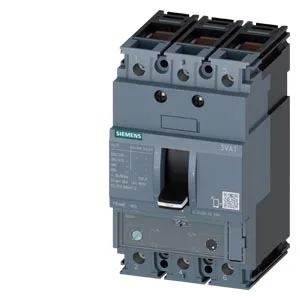
It carries 125 A continuously at 40 °C, and its interrupting capacity hits 75.6 kA at 240 V — enough to handle high-fault service-entrance or distribution panels where the available fault current is substantial. The TM240 release means the thermal element is calibrated for a 240 A frame — the breaker is physically built on that frame but shipped with a 125 A continuous rating, which gives you some flexibility if you need to up-rate the trip unit later without swapping the whole breaker.
Interrupting ratings — match them to your available fault current
This MCCB's interrupting capacity drops as system voltage rises: 75.6 kA at 240 V, 52.5 kA at 415 V, 32 kA at 440 V, and 11.9 kA at both 500 V and 690 V.
Thermal derating — don't lose capacity to a hot panel
Above that it starts to taper: 122 A at 55 °C, 120 A at 60 °C, 117 A at 65 °C, 114 A at 70 °C. That's not a showstopper for most loads, but worth factoring into the thermal coordination study.
Auxiliary and alarm switching built in
The auxiliary tracks the breaker's open/closed position; the trip alarm signals only when the breaker trips on fault, not on manual opening. That's useful for remote fault annunciation or a shunt-trip supervision circuit — saves adding an external accessory block for basic status feedback.
Panel fit — dimensions and power loss
Overall dimensions: 130 mm height, 76.2 mm width (3 inches — standard MCCB footprint for this class), 70 mm depth. Maximum power dissipation is 28.1 W — not negligible; if you're packing several of these side-by-side in a sealed box, you'll want to account for the heat in the enclosure sizing.
Environmental limits and approvals
The part carries Siemens SENTRON branding and is designed to IEC/EN 60947-2; compliance documentation (CE, RoHS, REACH) is standard with the shipment.