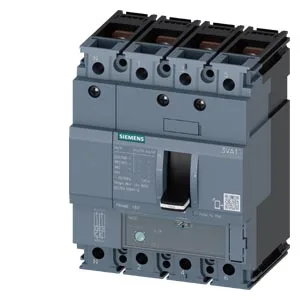
The TM220 thermal-magnetic release means the thermal element handles overloads and the magnetic element handles short circuits; no electronic adjustment, so it's a fixed-trip device suited for straightforward branch or feeder protection where you don't need adjustable trip curves. Breaking capacity is where this 4-pole MCCB earns its keep in high-fault installations: 76 kA at 240 V and 53 kA at 415 V. At 440 V it still clears 32 kA, and at 500 V and 690 V it holds 11.9 kA. Thermal derating is modest: still 125 A at 50 °C, dropping to 122 A at 55 °C, 120 A at 60 °C, and 114 A at 70 °C. That means in a warm panel — say 50 °C ambient — you don't lose any capacity. The 50% N-conductor protection means the neutral pole is rated at half the phase current, which is standard for 4-pole breakers in three-phase systems where the neutral carries only unbalanced current.
Panel fit and physical integration
The 3VA1112-3FE42-0AA0 measures 130 mm high, 101.6 mm wide, and 70 mm deep. The optional motor drive means you can add remote motorized operation if the application calls for it — useful for emergency-off or remote-disconnect schemes. No communication function built in, so it's a standalone breaker, not a smart metering device.