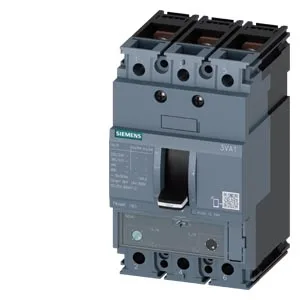
What this MCCB carries and what it doesn't
The Siemens SENTRON 3VA1112-4EF32-0AC0 is a 3-pole molded case circuit breaker rated for 125 A continuous current, fitted with a TM240 thermal-magnetic release. That TM designation means the thermal element handles overload protection and the magnetic element handles short-circuit — no electronic trip unit, no adjustable long-time or short-time curves. The 125 A rating holds flat from 40 °C through 50 °C, then derates to 120 A at 55 °C, 117.5 A at 60 °C, 115 A at 65 °C, and 112.5 A at 70 °C. If your panel ambient runs above 50 °C, size the breaker for the derated number, not the nameplate. Breaking capacity is 121 kA at 240 V, 75.6 kA at 415 V, 52.5 kA at 440 V, and 11.9 kA at 690 V. That 75.6 kA at 415 V is the figure most panel builders will care about for common 400 V distribution — it's high enough for most industrial main or feeder duty without needing a current-limiting upstream device. The 690 V figure drops to 11.9 kA, so if you're on a 690 V system, verify the available fault current before committing. This version is line protection only — no undervoltage release, no shunt trip, no ground-fault monitoring, no communication module, no phase-failure detection. The auxiliary contact package is 2 HQ (high-quality) switches, which is enough for a remote status signal but not for complex interlocking. If you need an undervoltage release or ground-fault alarm, you're looking at a different variant in the 3VA family.
Panel fit and mounting
Footprint is 76.2 mm wide, 130 mm tall, 70 mm deep. That 76.2 mm width is three 25.4 mm pole modules — standard for a 3-pole MCCB in a distribution board. IP40 on the front means it's protected against tools and wires >1 mm, but not against water ingress; keep it inside a panel enclosure, not on a washdown wall. Storage range is -40 °C to 80 °C, operating range -25 °C to 70 °C.
How it compares to the 3VA1112-5EF32-0CA0
The closest sibling in the 3VA family is the 3VA1112-5EF32-0CA0. Both are 125 A, 3-pole, TM240 breakers with the same dimensions and the same breaking capacities. The difference is the auxiliary contact count: this -4EF32 carries 2 HQ switches; the -5EF32 carries 1 HQ switch plus 1 alarm switch. If your panel wiring expects a separate alarm contact for the trip signal, the -5EF32 saves you an external auxiliary block. If you only need a single status feedback, either works — the -4EF32 gives you a spare contact for future use. Footprint is identical, so no rewiring or busbar rework if you swap between them.
