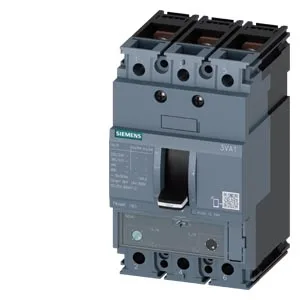
The interrupting capacity tells you where this breaker can sit in a distribution chain: 187 kA at 240 V, 121 kA at 415 V, 75.6 kA at 440 V, and 17 kA at 690 V. At 415 V — common in industrial panel feeds — that 121 kA means it handles high-fault scenarios without cascading upstream. The 690 V figure (17 kA) is the limit for 600 V class installations; if your transformer secondary is above that, you need a different frame. The thermal derating curve is flat from 40 °C to 50 °C (160 A), then drops to 153.6 A at 55 °C, 150.4 A at 60 °C, 147.2 A at 65 °C, and 144 A at 70 °C. If your panel ambient runs at 60 °C, plan for 150.4 A as the actual limit, not the nameplate 160 A.
Integration and auxiliary contact fit
The auxiliary release design is listed as 'without auxiliary release', so there is no shunt trip or undervoltage release in this variant; if you need remote tripping, order a different option suffix. That 76.2 mm is a standard 3-pole MCCB footprint for a 160 A frame — it fits the same panel cutout as the 3VA1112-5EF32-0CA0 (lower ampacity sibling) without rewiring the bus bars, as long as the lugs accept the same conductor size.
If your application cycles the breaker daily, that is about 41 years of service; if it cycles multiple times per shift, consider a contactor for the load switching and keep the MCCB for fault protection only.