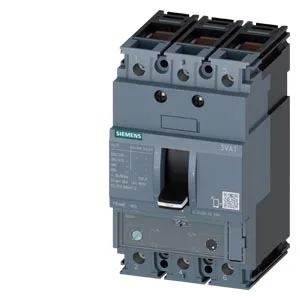
The Siemens SENTRON 3VA1116-5EF36-0HH0 is a 3-pole molded case circuit breaker rated for 160 A continuous at 40 °C, with no derating needed up to 50 °C — the full 160 A holds through that range. At 55 °C it carries 158 A, at 60 °C it's 155 A, and at 70 °C it's 150 A, so the thermal curve is predictable for a warm enclosure. The interrupting capacity is 187 kA at 240 V, 121 kA at 415 V, and 75.6 kA at 440 V — that SCCR headroom means it can sit upstream of a high-fault distribution point without cascading failure. This is a line-protection breaker (not a motor-protection or feeder-only device), so its trip curve is optimized for cable and busbar protection in distribution panels. Maximum power loss is 38 W, which matters for thermal budgeting in a sealed or high-fill-factor enclosure.
The breaker occupies 76.2 mm width (3 in) by 130 mm height (5.12 in) by 70 mm depth (2.76 in) — a standard 3-pole MCCB footprint that fits most DIN-rail or panel-mount enclosures without re-drilling.
For selectivity studies, the 160 A continuous rating and the line-protection trip curve should coordinate downstream with 100 A or smaller feeder breakers, provided the manufacturer's selectivity tables are followed. The shunt trip release allows remote emergency tripping from a safety PLC or E-stop circuit, which is useful for coordinated shutdown sequences.