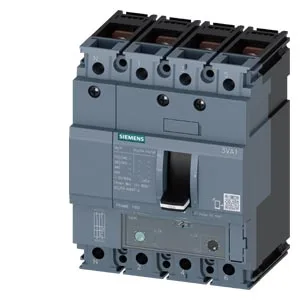
Four poles, rated 160 A continuous at 40 °C — and it holds that same 160 A all the way up to 50 °C before it starts to derate (158 A at 55 °C, 155 A at 60 °C, 153 A at 65 °C, 150 A at 70 °C). That thermal curve means you don't lose headroom in a warm enclosure; the breaker is effectively flat-rated through most real-world panel ambient conditions. Breaking capacity is the headline number for fault duty: 187 kA at 240 V AC, 121 kA at 415 V, 75.6 kA at 440 V, and still 17 kA at 500 V and 690 V. That's a high-interrupting rating for a 160 A frame — it handles high available fault current at the lower voltages typical of North American 240/480 V panels, and still clears at 690 V for European or marine distribution. Insulation voltage rated 800 V, so the internal clearances are built for 690 V systems without derating the dielectric.
Panel integration — what the dimensions mean for the cutout
Width 101.6 mm (4 in), depth 70 mm (2.76 in), height 130 mm (5.12 in). The 4-pole width is fixed; if your panel was laid out for a 3-pole frame, you'll need the extra module space. DIN-rail or screw-mount, the footprint is the same across the 3VA family, so swapping between variants doesn't require re-drilling the backplate.
What's on the breaker — auxiliary and release configuration
The UVR means the breaker trips when control voltage drops — common for emergency-stop circuits or undervoltage protection on motor feeders. No ground-fault monitoring module on this variant (the 'Without' ground-fault version). Trip indicator is present, so you get a visual flag on the front after a fault trip.