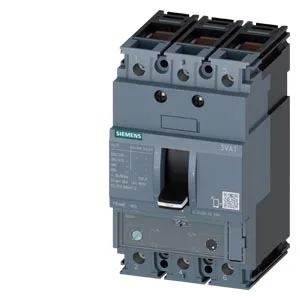
Its TM240 thermal-magnetic overcurrent release provides fixed protection against overload and short circuits. The part carries a 187 kA breaking capacity at 240 V, tapering to 121 kA at 415 V, 75.6 kA at 440 V, and 17 kA at 690 V — these are the interrupting ratings that govern its placement in the fault-current hierarchy of a panel.
At 240 V the 187 kA rating places this MCCB well above the typical utility fault-current range for North American 240/120 V split-phase services. At 415 V the 121 kA figure covers most industrial secondary-side transformer faults.
Above that the thermal-magnetic trip begins to shift: 24 A at 55 °C, 23.5 A at 60 °C, 23 A at 65 °C, and 22.5 A at 70 °C. If the breaker is mounted in a sealed enclosure or next to heat-generating gear, size the load current against the derated value at the actual cabinet ambient. Dimensions are 70 mm deep, 76.2 mm wide, 130 mm high, fitting standard SENTRON 3VA panel footprints.
The UVR is specified as design type 3VA9608-0BB24. The auxiliary contacts can be wired into a PLC input for remote status of the breaker position.