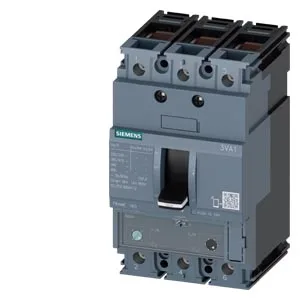
It's a line-protection device — meaning it sits between the transformer or main bus and a distribution panel, not on a motor branch. The interrupting ratings climb to 75.6 kA at 240 V and 52.5 kA at 415 V, so it handles high-fault scenarios typical of industrial switchgear without needing an upstream current-limiting fuse. That means the 32 A rating is baked in; if the load changes, you swap the breaker, not the trip.
Interrupting capacity — what those numbers mean for your panel
At 415 V (common in European 400 V grids) it still holds 52.5 kA, which covers most industrial service-entrance faults. At 440 V it drops to 32 kA, and at 690 V it's 10.5 kA — still usable for 690 V drives or mining gear, but you need to verify the available fault current at the point of installation.
Thermal derating — don't let the panel oven fool you
At 55 °C it derates to 30.72 A, at 60 °C to 30.08 A, at 65 °C to 29.44 A, and at 70 °C to 28.8 A. The IP40 front protection means it's splash-proof from the front but not sealed; mount it inside a cabinet, not outdoors.