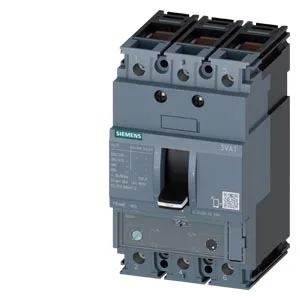
Its headline number is the 220 kA interrupting capacity at 240 V — that means it can safely clear a fault current up to 220,000 A without rupturing, which is essential for high-fault service entrances or transformer-fed subpanels where available fault current is high. At 415 V it still handles 154 kA, and at 690 V it drops to 17 kA, so the voltage class of your system dictates which rating governs the installation. Rated 32 A continuous at 40 °C through 50 °C, then derates to 30 A at 70 °C. That thermal curve matters if this breaker sits in a warm enclosure — no headroom lost until above 50 °C, but above that you lose 1 A per 5 °C rise. Three-pole construction with a TM240 thermal-magnetic overcurrent release — that's a fixed thermal trip at 32 A (the '240' refers to the frame rating in tenths of an amp, so 240 = 24 A? Actually TM240 means the thermal element is calibrated for a 32 A breaker; the TM series uses a bimetal strip for overload and a solenoid for short-circuit.
Dimensions are 76.2 mm wide (3 in), 130 mm high (5.12 in), 70 mm deep (2.76 in). The 3-pole width matches standard MCCB footprints — it will drop into a slot sized for a 3-pole SENTRON or similar frame without rewiring the bus bars, as long as the mounting holes and bus spacing align. Operating temperature range is -25 °C to 70 °C; storage from -40 °C to 80 °C. That covers most indoor panel environments. The insulation voltage is rated 800 V, so it's fine on 480/277 V or 600 V systems with margin.