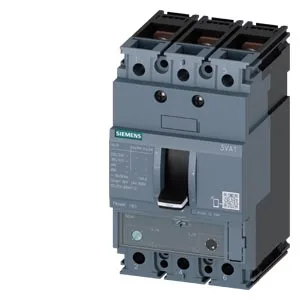
It's a 3-pole unit rated 40 A continuous at 40 °C, with an interrupting capacity of 187 kA at 240 VAC — that's a serious fault-current rating, sized for high-available-fault panels where a standard 25 kA or 65 kA breaker would weld shut on a bolted fault.
The 40 A frame is non-ambient-compensated up to 50 °C — it holds full rating at 40, 45, and 50 °C, then derates to 39 A at 55 °C and 37 A at 70 °C (–). The interrupting curve drops steeply with voltage: 187 kA at 240 V, 121 kA at 415 V, 75.6 kA at 440 V, and 17 kA at 500/690 V (–). For a 480 V delta system you're looking at the 75.6 kA figure — still substantial, but verify against your transformer impedance and available fault current study. That's a standard 3-pole MCCB width for a 160 A frame — it'll bolt into a SENTRON panelboard or a DIN-rail adapter plate. The UVR means if control voltage drops below dropout, the breaker opens — common for emergency-stop chains or undervoltage protection on machine tools. That's the heat the breaker dumps into the enclosure — for a multi-breaker panel, sum those losses and size your ventilation or cooling accordingly. The basic switch assembly is order code 3VA11405EF320AA0 — that's the internal mechanism; not a field-replaceable item for most shops, but good to know for spares planning.