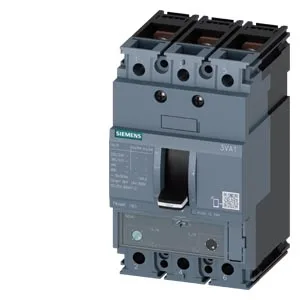
That 40 A holds flat from 40 °C through 50 °C (–); above that it derates to 38.4 A at 55 °C and 36 A at 70 °C. The interrupting capacity is the headline here — 187 kA at 240 V, 121 kA at 415 V, 75.6 kA at 440 V, and still 17 kA at 690 V. That's high-rupture capability for a 40 A frame, sized for high-fault industrial panels where you need selectivity without stepping up to a bigger breaker. The shunt trip (STL) auxiliary release lets you trip remotely via a control signal — common in emergency-stop chains or PLC-driven disconnect sequences. Front protection is IP40, so it's panel-mount only; no washdown rating.
The 3VA1140-5EF32-0JA0 occupies a 3-pole footprint at 76.2 mm wide, 130 mm tall, 70 mm deep. The TM240 release is thermal-magnetic, so no external power supply needed for the overcurrent protection; the shunt trip (STL) does need a control voltage to fire. No auxiliary contacts are fitted, and there's no undervoltage release, no ground-fault module, no communication function.
How the interrupting ratings govern your panel
For a 480 V panel (common in North America), the 75.6 kA at 440 V is the closest published figure — expect similar or slightly lower at 480 V. The latching endurance is 15,000 operations — that's mechanical life, not electrical; for frequent switching, factor in contact wear.