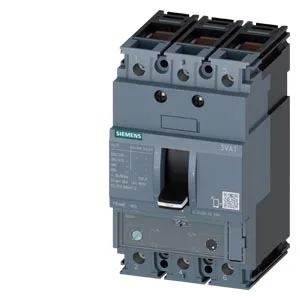
What it is and what it does
The Siemens SENTRON 3VA1140-6EF36-0AG0 is a 3-pole molded case circuit breaker (MCCB) designed for line protection in industrial distribution panels. It carries a 40 A continuous rating across the ambient range from 40 °C to 50 °C, with only a 3 A derating by 70 °C — meaning it holds its rating through most normal panel temperatures without upsizing the frame. The TM240 thermal-magnetic release handles overload and short-circuit protection in one unit. The thermal element tracks load current over time; the magnetic element trips instantaneously on high faults. A trip indicator on the front confirms the breaker opened on a fault, not a manual switch-off — useful when you're tracing a nuisance trip on a paper-machine feeder. Breaking capacity is the headline number that decides whether this breaker clears a fault without exploding. At 240 V it interrupts 220 kA; at 415 V, 154 kA; at 440 V, 121 kA; at 500 V and 690 V, 17 kA. The steep drop above 440 V means you need to verify the available fault current at the point of installation — in a 690 V mill distribution section, 17 kA is the ceiling.
Where it fits in the panel
The breaker occupies a 76.2 mm wide (3 in) footprint on the DIN rail or mounting plate, 130 mm tall and 70 mm deep. That's a standard SENTRON 3VA frame size — it drops into the same cutout and bus-bar spacing as other 3VA breakers in the family. The 70 mm depth (2.76 in) leaves room for rear-connected bus bars or a shallow enclosure back wall. Rated insulation voltage is 800 V, so the internal clearances and creepage are sized for 690 V systems with margin. Power loss at full load is 10.8 W — negligible for a single breaker, but if you're packing a dozen of these in a sealed stainless-steel mill panel, that 130 W total needs to be in the thermal budget.
Lifecycle and sourcing reality
The auxiliary switch configuration is factory-fitted: one auxiliary contact plus one trip-alarm switch (HP type). That covers remote status feedback — breaker on/off and fault-tripped — without adding a separate accessory module. No undervoltage release, no ground-fault monitoring, no communication module on this variant; those are separate order codes if the application needs them.
