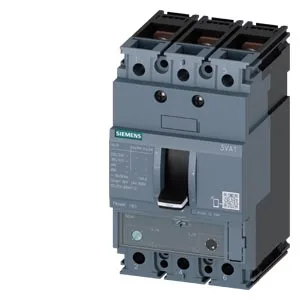
It carries a rated continuous current Iu of 50 A, and that 50 A holds flat from 40 °C up through 50 °C ambient; it derates to 48 A at 55 °C and steps down to 45 A at 70 °C. The TM240 overcurrent release is a thermal-magnetic type — thermal for overload protection, magnetic for short-circuit — with an adjustable long-time delay tr max. of 1 second.
This MCCB delivers 187 kA breaking capacity at 240 V, 121 kA at 415 V, 75.6 kA at 440 V, and 17 kA at 690 V. For a 480 V panel (common in North America) the relevant figure is the 440 V rating of 75.6 kA, which covers most industrial service-entrance and feeder duties. At 690 V the 17 kA rating still handles motor branch circuits on 600 V class systems.
The 76.2 mm width (3 inches) is the standard 3-pole MCCB footprint for SENTRON 3VA frames — it occupies three 25.4 mm module positions on a DIN rail or mounts directly to a backplate.
The 50 A continuous current at 40 °C is the thermal benchmark; if your panel ambient runs above 50 °C, use the derated values (48 A at 55 °C, 47 A at 60 °C, etc.) to avoid nuisance tripping. The 15 000 mechanical endurance cycles (latching endurance) means the breaker mechanism is rated for that many open-close operations under no-load conditions — relevant for applications where the MCCB is used as a disconnect switch, not just an overcurrent protector.