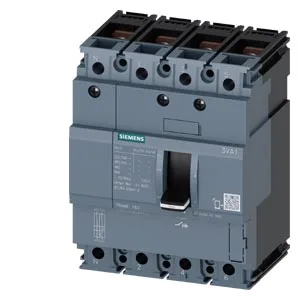
Its TM210 thermal-magnetic overcurrent release provides fixed thermal and magnetic trip settings, so no adjustment modules are needed; the breaker is sized at 63 A continuous at 40 °C ambient and holds that rating all the way to 50 °C before it begins to derate (62 A at 55 °C, 61 A at 60 °C, 60 A at 65 °C, 58 A at 70 °C). That thermal stability means you can pack this breaker into a warm enclosure without losing headroom — a real advantage in a crowded panel. The interrupting ratings are what decide the fit for your service entrance or subfeed. At 240 V it clears 121 kA — high enough for most industrial secondary-side applications. At 415 V it's 75.6 kA, at 440 V it's 52.5 kA, and at 500 V and 690 V it drops to 11.9 kA. Four poles with no undervoltage release, no trip indicator, no communication function, and no ground-fault monitoring. This is a straightforward thermal-magnetic MCCB — no auxiliaries, no electronics. Mount it in a dry, lockable panel.
Dimensions: 101.6 mm wide (4 in), 130 mm tall (5.12 in), 70 mm deep (2.76 in). That 4-pole width is the critical dimension for DIN-rail or panel-mount layouts — it occupies four 18 mm module spaces if using a modular mounting base, or the manufacturer's standard MCCB footprint. Maximum power loss is 17.3 W. That is the heat the breaker dissipates at full rated current. A 17.3 W loss per breaker is modest — typically not a ventilation driver unless you have a dozen units in one box.