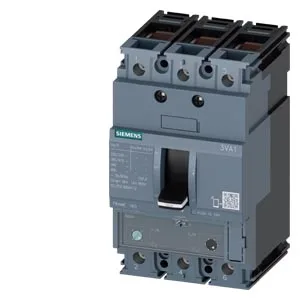
The Siemens SENTRON 3VA1163-4EF36-0JA0 is a 3-pole molded case circuit breaker (MCCB) rated for 63 A continuous current at up to 50 °C, with a TM240 thermal-magnetic overcurrent release. The interrupting capacity at 240 V is 121 kA, dropping to 75.6 kA at 415 V and 52.5 kA at 440 V; at 690 V it still holds 11.9 kA, which covers most industrial 690 V bus applications.
Above that, it starts to step down: 60.48 A at 55 °C, 59.22 A at 60 °C, 57.96 A at 65 °C, and 56.7 A at 70 °C. If your panel ambient runs at 60 °C, you're losing about 4 A of headroom — factor that into the load calculation rather than relying on the 63 A nameplate.
What the TM240 release means for fault coordination
The TM240 designation indicates a thermal-magnetic trip unit with a fixed thermal pickup of 63 A (the frame rating) and a magnetic short-circuit pickup set at 240 A. That's 3.8x the continuous rating — typical for motor branch circuits or distribution feeders where you want to ride through inrush without nuisance tripping. The thermal element handles overloads on a time-current curve; the magnetic element clears hard shorts instantaneously.
The 130 mm height and 76.2 mm width are standard for the SENTRON 3VA frame; the 70 mm depth leaves room behind the door for wiring and bus connections. No communication module, no phase-failure detection — it's a straightforward line-protection breaker, not a smart device.