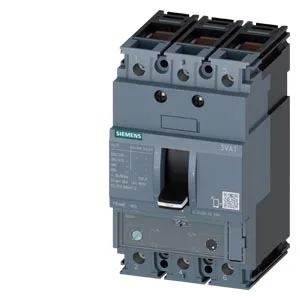
Breaking capacity across voltages
The 3VA1163-5EF36-0DA0: The interrupting rating drops as system voltage rises: 121 kA at 415 V, 75.6 kA at 440 V, and 17 kA at both 500 V and 690 V. For a 480 V panel (common in North America), you'd use the 440 V figure as a conservative benchmark — 75.6 kA still covers most industrial service entrances.
Thermal derating and ambient limits
Above that, it derates linearly: 62 A at 55 °C, 61 A at 60 °C, 60 A at 65 °C, and 58 A at 70 °C.
Undervoltage release and line protection design
It's designed for line protection, meaning it's set up to guard the feeder, not a specific motor or load. The trip indicator is absent, so you won't get a local flag — plan on using the auxiliary contact block if you need remote status.
Panel fit and power loss
Dimensions: 130 mm high, 76.2 mm wide (3 inches — standard for a 3-pole MCCB), 70 mm deep. That's a 3-inch-wide footprint, so it fits a standard distribution panel cutout.