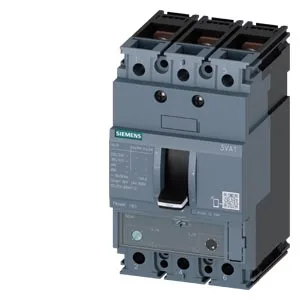
The Siemens SENTRON 3VA1196-3EF32-0CH0 is a 3-pole molded case circuit breaker (MCCB) rated for 16 A continuous current, with a breaking capacity that reaches 75.6 kA at 240 V AC and 52.5 kA at 415 V AC. It is designed for line protection — meaning it sits at the incoming feeder or main distribution point in a panel, not downstream on a motor or branch circuit. The 70 mm depth and 76.2 mm width fit standard SENTRON mounting footprints, so it drops into existing 3VA-series panel layouts without re-drilling the backplate.
Breaking capacity and what it means for your fault level
This breaker's interrupting rating drops as system voltage rises — 75.6 kA at 240 V, 52.5 kA at 415 V, 32 kA at 440 V, and 11.9 kA at both 500 V and 690 V. That 11.9 kA at 690 V is the number to watch if you are feeding a 690 V drive or transformer; it tells you the available fault current at that voltage must stay below that threshold. The rated insulation voltage of 800 V confirms the internal clearances are designed for 690 V line-to-line systems, not just 400 V.
Thermal derating and continuous current
The 16 A rating holds flat from 40 °C up to 55 °C ambient — no derating needed in a typical ventilated enclosure. At 60 °C and 65 °C it drops to 15 A; at 70 °C it stays at 15 A. If your panel runs hot near the top of a sealed cabinet, factor that 1 A reduction. Maximum power loss is 13.1 W, which is modest for a 3-pole MCCB and won't drive significant internal heat rise in a standard enclosure.
Integrated undervoltage release and auxiliary switch complement
This unit ships with an undervoltage release (UVR) built in — the 3VA1196-3EF32-0CH0 will trip if control voltage drops below the UVR threshold, which is standard for applications that need under-voltage protection on a feeder (e.g., to prevent motor re-acceleration after a dip). The auxiliary switch configuration is 2 auxiliary switches plus 1 trip alarm switch (HQ), giving you two NO/NC contacts for status feedback and a dedicated alarm contact that changes state only on a fault trip. A trip indicator on the front face gives local visual confirmation without needing to read the aux contacts.
