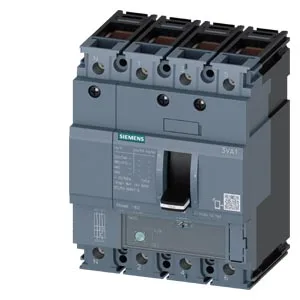
MCCB for line protection — 16 A, 4-pole, TM220 release
The 3VA1196-4EE46-0AA0: Breaking capacity is the headline number here: 121 kA at 240 V AC, 75.6 kA at 415 V, 52.5 kA at 440 V, and 11.9 kA at both 500 V and 690 V. At 240 V, that 121 kA rating puts it in the high-interrupting category for a 16 A frame — it can ride through a bolted fault on a large transformer secondary without rupturing. The drop to 11.9 kA at 690 V is typical for this class; the arc energy at higher voltage limits what a compact MCCB can interrupt, so verify the available fault current at your system voltage against these curves. Thermal derating is flat from 40 °C through 55 °C — still 16 A — then drops to 15 A at 60 °C and holds there through 70 °C. That means in a warm panel (say 50 °C ambient), you get full ampacity; only above 55 °C do you lose 1 A. The operating range is -25 °C to 70 °C, storage from -40 °C to 80 °C. Power loss at full load is 10.6 W per pole, so four poles dissipate about 42 W total — factor that into enclosure ventilation if the panel is densely packed.
Panel fit and physical integration
Dimensions are 130 mm height, 101.6 mm width, 70 mm depth — a standard MCCB footprint for the 160 A frame class. The 70 mm depth (2.76 in) is shallow enough for most 200 mm deep enclosures. IP40 on the front means protection against tools and wires >1 mm, but not against water ingress; mount it inside a rated enclosure if washdown or outdoor exposure is expected. No undervoltage release, no shunt trip, no communication module — this is a plain thermal-magnetic breaker for basic line protection.
