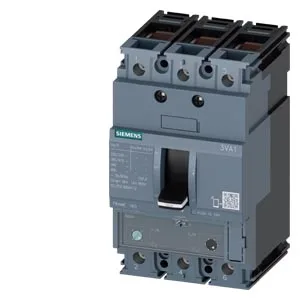
The Siemens SENTRON 3VA1196-5EF36-0JC0 is a 3-pole molded case circuit breaker rated for 16 A continuous current and a breaking capacity of 187 kA at 240 V AC, 121 kA at 415 V, and 75.6 kA at 440 V. That kind of interrupting rating means it can sit upstream of a large transformer or feed a switchboard where fault current runs high — the breaker clears a bolted fault without venting or welding contacts. The TM240 thermal-magnetic release handles overloads and short circuits in one package; no electronic trip unit, so no auxiliary power needed for the trip logic. It's built for line protection (cable and busbar protection), not motor or generator duty. The shunt trip (STL) release lets a remote signal — fire alarm, emergency-stop relay, or a PLC digital output — force the breaker open without an operator at the handle. It ships with two HQ (high-performance) auxiliary switches for status feedback to a DCS or panel lamp. No undervoltage release, no ground-fault module, no communications card; this is a straightforward, high-interrupting MCCB for a distribution panel where the protection engineer wants selectivity without electronics.
The 16 A rating holds flat up to 50 °C ambient; above that it derates to 15.36 A at 55 °C, 15.04 A at 60 °C, 14.72 A at 65 °C, and 14.4 A at 70 °C. The 70 mm depth and 76.2 mm width fit a standard SENTRON 3VA footprint; it occupies one 4-module-wide slot on a DIN rail or mounting plate.