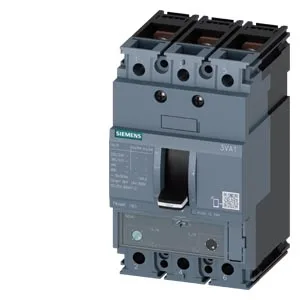
Breaking capacity is the headline number that decides whether this breaker clears a fault without welding or rupturing: 121 kA at 240 V AC, 75.6 kA at 415 V, 52.5 kA at 440 V, and 11.9 kA at 690 V.
Thermal-magnetic release and temperature derating
The breaker holds 16 A from 40 °C up to 50 °C, then begins to derate: 15.36 A at 55 °C, 15.04 A at 60 °C, 14.72 A at 65 °C, and 14.4 A at 70 °C. The magnetic trip is fixed inside the TM240 release — no field-adjustable magnetic setting. For applications needing adjustable short-circuit pickup, a different release variant (e.g., an electronic ETU) would be the correct choice. This part is a straight thermal-magnetic, line-protection MCCB.
That gives remote status of the breaker position (ON/OFF) and a separate alarm contact that closes only when the breaker trips on fault — useful for PLC inputs, annunciator panels, or safety circuits that need a dedicated trip signal. An undervoltage release (UVR) is fitted as standard. The specific auxiliary trip module order code for this build is 3VA9608-0BB11, which is the UVR module itself.
Footprint: width 76.2 mm, height 130 mm, depth 70 mm. Depth of 70 mm leaves room behind the door for wiring space; the front face carries a trip indicator (red flag visible when tripped) and an IP40 protection rating on the front, meaning tools or fingers cannot reach live parts from the front, but the sides and rear are not sealed against dust ingress. The breaker is designed for fixed mounting (not plug-in) and accepts copper or aluminum cable lugs. The TM240 release is non-interchangeable in the field — if you need a different rating, you replace the whole MCCB, not just the trip unit.