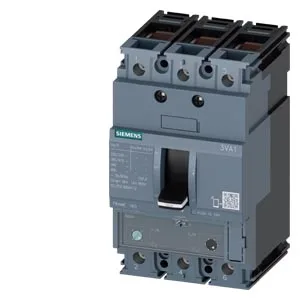
Its 16 A rated continuous current (Iu) holds flat from 40 °C to 50 °C, then derates to 14.4 A at 70 °C — so in a warm enclosure you lose about 1.6 A off the nameplate. The TM240 thermal-magnetic release handles overload and short-circuit trip curves without electronics, which means no auxiliary power draw and no communication module to fail. Breaking capacity is the headline: 121 kA at 240 V, 75.6 kA at 415 V, 52.5 kA at 440 V, and 11.9 kA at 690 V. The 690 V rating (11.9 kA) is low but still covers most motor-circuit fault levels at that voltage. The shunt trip (STL) release is built in (auxiliary release design), so you can remotely trip the breaker — useful for emergency-stop circuits or PLC-driven shutdowns.
How it compares to a sibling
The closest functional peer in the SENTRON 3VA family is the 3VA1110-5EE32-0JA0. That unit is a higher-current variant with electronic release, so it targets main feeders rather than branch protection.
Width 76.2 mm, height 130 mm, depth 70 mm — fits standard 3-pole MCCB cutouts in SENTRON distribution boards. The shunt trip (STL) is wired separately; verify polarity on the release coil before energizing. No auxiliary contact version means you cannot wire a remote status signal from this breaker alone — add a separate auxiliary switch block if you need feedback. The 15 000 mechanical endurance cycles are typical for this class — fine for panel switching, not for frequent motor starting. For DC-network applications, consult the 3VA molded case circuit breaker device manual (link in Service & Support).