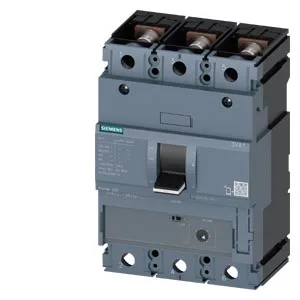
Rated 160 A continuous (Iu) with a TM120M thermal-magnetic trip unit, it handles the locked-rotor inrush of a motor without nuisance tripping on start, then clears a fault fast when it matters. The 3-pole body carries a 187 kA interrupting rating at 240 V and 121 kA at 415 V, so it can sit upstream of a motor starter in a high-fault-capacity panel without needing a current-limiting fuse ahead of it.
The interrupting ratings span the voltages you'll actually see on a plant floor: 187 kA at 240 V, 121 kA at 415 V, 30 kA at 440 V, and 17 kA at 690 V. That's enough headroom for most industrial switchboards; you won't need to series-rate it with a fuse for typical motor control center applications. The 690 V rating (17 kA) covers the odd 690 V mining or marine distribution bus.
Thermal derating — don't let the 160 A sticker fool you
At 55 °C it derates to 153.6 A, at 60 °C to 150.4 A, at 65 °C to 147.2 A, and at 70 °C to 144 A. The TM120M release's thermal element tracks this curve, so a 150 A motor at 60 °C ambient is fine; a 155 A load at 65 °C is not.
Built-in undervoltage release — what it changes
The UVR coil is the 3VA9608-0BB24 accessory; if you're replacing one in a panel, that's the spare part number for the release itself. No auxiliary contacts are included on this build (auxiliary contact version: without), so if you need a status feedback signal for the PLC, you'll add a 3VA9 series auxiliary switch block separately.
Physical fit — panel integration notes
That 105 mm width is standard for a 3-pole 160 A MCCB in the 3VA frame — it occupies three 35 mm DIN modules worth of panel space if mounted on a DIN rail, or bolts directly to a mounting plate via the rear slots. The 70 mm depth leaves clearance for rear-connected bus bars or a cable entry gland plate behind the breaker.