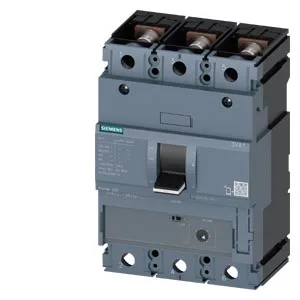
MCCB for motor starter protection
The Siemens SENTRON 3VA1216-5MH32-0BH0 is a 3-pole molded case circuit breaker rated for 160 A continuous current (Iu) and built specifically for starter protection duty — meaning it's sized to sit ahead of a motor starter combination, not as a feeder breaker in a distribution panel. The TM120M thermal-magnetic release provides the inverse-time overload curve and short-circuit magnetic trip, with a latching endurance of 15 000 operations, so it's rated for the switching cycles a motor branch sees over its service life.
Breaking capacity and coordination headroom
At 240 V the interrupting rating is 187 kA; at 415 V it's 121 kA; at 440 V it drops to 30 kA; and at 690 V it's 17 kA. That 415 V figure is the one to size against for most European 400 V line-to-line systems — 121 kA gives generous headroom for high-fault panels without needing a current-limiting upstream breaker. The 690 V rating of 17 kA still covers most industrial motor branch circuits at that voltage class.
Thermal derating and ambient limits
The breaker holds its full 160 A rating up to 50 °C ambient. Above that it derates: 153.6 A at 55 °C, 150.4 A at 60 °C, 147.2 A at 65 °C, and 144 A at 70 °C. If the panel ambient runs above 50 °C — say, a sealed enclosure near a furnace line — size the continuous load against the 55 °C or 60 °C column, not the 160 A nameplate. Operating range is -25 °C to 70 °C, storage from -40 °C to 80 °C.
Auxiliary and undervoltage release configuration
This variant ships with an undervoltage release (UVR) and a 2-auxiliary-switch plus 1-trip-alarm-switch contact block (HQ). The integrated auxiliary trip order code is 3VA9608-0BB11. No communication function, no phase-failure detection, no ground-fault monitoring — it's a pure electromechanical protection device. The trip indicator on the front gives a visual flag after a fault, which saves a technician from having to guess whether the breaker tripped or was manually opened.
