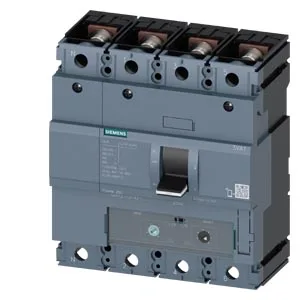
What this MCCB is and what the ratings mean for fit
The Siemens 3VA1220-6FF42-0AA0 is a SENTRON molded case circuit breaker (MCCB) designed for line protection — the primary feeder breaker in a distribution panel, sized to protect cable and bus from overload and short circuit. It's a 4-pole unit on a 100 A frame, meaning the physical breaker body and its thermal-magnetic trip unit (TM240) are rated to carry 100 A continuously at 40 °C ambient without derating. At 40 °C it's good for 200 A continuous; that headroom drops gradually to 176 A at 70 °C, so if this breaker lives in a hot enclosure you'll want to check the actual load against the thermal curve. The interrupting ratings are what separate this from a standard MCB. At 240 V it clears 220 kA — that's a very high fault-current capability, sized for the main breaker position close to a large transformer. At 415 V it's still 154 kA, at 440 V it's 75.6 kA, at 500 V it drops to 30 kA, and at 690 V it's 17 kA. If your system voltage lands between those test points, the lower adjacent rating governs; don't interpolate upward. The TM240 trip unit is a fixed thermal-magnetic design — no electronic adjustment, no communication function, no ground-fault monitoring.
Panel fit — dimensions and integration
The case dimensions are 158 mm tall, 140 mm wide, and 70 mm deep. That 70 mm depth is the body only; add clearance for the arc chute exhaust and termination lugs. The 140 mm width for a 4-pole MCCB is standard — it occupies roughly 5.5 inches of DIN-rail or mounting-plate space. If you're swapping this into an existing panel, measure the available width first; a 3-pole unit won't fit the same footprint. Maximum power loss is 42 W at rated load. That's heat that stays inside the enclosure — factor it into your thermal budget if the panel is sealed or tightly packed.
