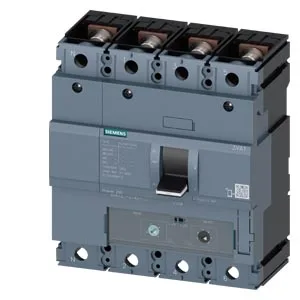
The Siemens SENTRON 3VA1220-6EF42-0JH0 is a 4-pole molded case circuit breaker rated 200 A continuous at 40 °C through 50 °C, with a slight thermal derating to 176 A at 70 °C. That 200 A frame holds steady across a 40–50 °C enclosure ambient — useful when the panel sits in a warm machine bay or near a drive cabinet. The real headline is the interrupting capacity: 220 kA at 240 V, 154 kA at 415 V, 75.6 kA at 440 V, 30 kA at 500 V, and 17 kA at 690 V. Those numbers mean this breaker can ride through a bolted fault at a 415 V distribution board and still clear without welding its contacts — it's sized for high-fault-current industrial mains, not a light commercial sub-panel. The shunt trip (STL) auxiliary release lets a safety PLC or E-stop circuit force the breaker open remotely, and the built-in trip indicator gives a visual flag on the fascia so a technician walking the row sees which pole tripped without opening the door.
The breaker occupies 140 mm width, 158 mm height, and 70 mm depth — a 4-pole frame that fits standard Siemens SENTRON 3VA mounting plates and busbar systems. The auxiliary switch package includes 2 auxiliary switches plus a trip alarm switch (HQ design), so you get both a status mirror and a separate fault-indication contact for the PLC. The shunt trip release (STL) is factory-fitted; wire it to a 24 VDC or 110–240 VAC control signal depending on the release coil ordered separately.