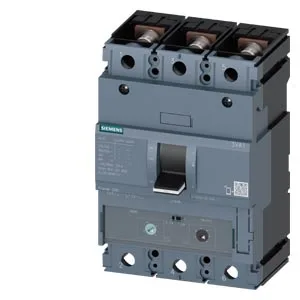
What this MCCB handles — and where it lives
That 250 A holds flat from 40 °C up to 50 °C, then derates to 243.3 A at 55 °C, 236.5 A at 60 °C, 229 A at 65 °C, and 223 A at 70 °C — so in a hot cement-plant or kiln-side panel you lose about 11 % of the headline rating by the time ambient hits 70 °C. Breaking capacity runs 121 kA at 240 V, 75.6 kA at 415 V, 25 kA at 440 V, and 11.9 kA at 690 V. That 75.6 kA at 415 V is the number that matters for most 400 V industrial distribution — it clears a bolted fault upstream of a 1000 kVA transformer without the arc flash climbing past the gear rating.
Thermal-magnetic release and auxiliary contacts
Dimensions are 105 mm wide × 158 mm high × 70 mm deep. That 105 mm width (about 4.1 inches) is a standard 3-pole MCCB footprint — it occupies roughly four 27 mm module spaces on a DIN rail or a bolt-on mounting plate. Front protection is IP40, so it keeps out tools and fingers but not dust; in a cement plant or mill environment you'll want it behind a sealed enclosure door. The TM240 release is not adjustable for time-current curves — it's a fixed thermal-magnetic, so coordination studies need the published trip curves, not field tweaks.