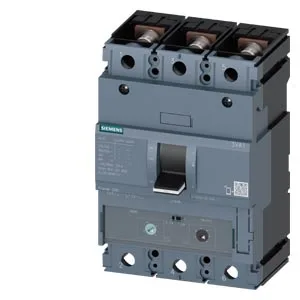
What the 250 A continuous rating means for your panel
At 40 °C ambient, it carries the full 250 A without derating; the curve holds flat through 50 °C, then drops to 243.3 A at 55 °C, 236.5 A at 60 °C, 229 A at 65 °C, and 223 A at 70 °C. For a mill panel near a furnace or drive cabinet pulling ambient above 50 °C, that thermal headroom matters — you size the breaker for the load at actual cabinet temperature, not the nameplate number. Breaking capacity is the other number that decides whether this breaker holds or vents on a fault. At 240 V it interrupts 121 kA; at 415 V, 75.6 kA; at 440 V, 25 kA; at 690 V, 11.9 kA. If your upstream transformer can deliver 65 kA at the bus, this breaker clears it with margin. This is a line-protection version: it protects cable and bus from overload and short, not a motor or a downstream device with specific coordination curves. The auxiliary contacts are two HQ switches (form C), and there's an undervoltage release (UVR) integrated — if the control voltage drops, the breaker trips. That UVR is a separate order: 3VA9608-0BB25.
Panel fit and mounting — what the dimensions tell you
IP40 on the front keeps dust out of the mechanism; the rest of the breaker is ventilated for thermal performance, so don't seal it inside a closed box without checking the temperature derate curve above.