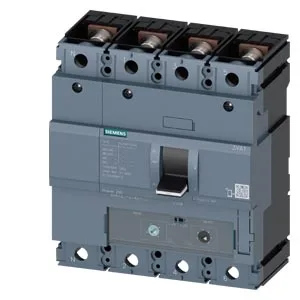
The Siemens SENTRON 3VA1225-4EF42-0BA0 is a 4-pole molded case circuit breaker (MCCB) rated for line protection, carrying a continuous current of 250 A at 40 °C. This is the current it'll hold all day in a 40 °C panel — no derating needed at that ambient. The TM240 thermal-magnetic release handles overloads and short-circuits; the built-in undervoltage release (UVR) trips the breaker if control voltage drops, which is standard for motor feeder disconnects and emergency-stop chains.
Breaking capacity — what it means for fault duty
This MCCB interrupts 121 kA at 240 V AC, 75.6 kA at 415 V, 52.5 kA at 440 V, 17 kA at 500 V, and 11.9 kA at 690 V. Those numbers are the maximum fault current the breaker can safely clear at each voltage level. If your panel's available fault current at the line side exceeds the rating at your system voltage, you need a current-limiting upstream device or a higher-rated frame. The 121 kA at 240 V is typical for North American 120/240 V split-phase service entrances; the 75.6 kA at 415 V covers most European 400 V industrial distribution.
Thermal derating and operating range
The breaker holds 250 A continuously from 40 °C up through 50 °C. Above that, it derates: 243 A at 55 °C, 237 A at 60 °C, 230 A at 65 °C, and 223 A at 70 °C. If your panel runs hot — say a sealed enclosure in a Gulf Coast plant — that 70 °C figure (223 A) is what you spec to. The operating ambient range is -25 °C to 70 °C; storage from -40 °C to 80 °C. Rated insulation voltage is 800 V, so it's comfortable on 690 V systems with margin.
Panel fit and integration
Dimensions are 158 mm high, 140 mm wide, 70 mm deep — a standard 4-pole MCCB footprint for DIN-rail or panel-mount. The 70 mm depth means it clears most shallow enclosures. Power loss at rated current is 59.5 W; account for that heat in your enclosure thermal calculation. The TM240 release is fixed-trip, not adjustable, so the overload curve is set at the factory. No communication function, no ground-fault monitoring — this is a straight line-protection breaker with undervoltage release.
