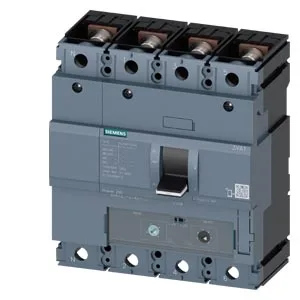
The Siemens SENTRON 3VA1225-4EF42-0DC0 is a 4-pole molded case circuit breaker (MCCB) rated for a continuous current Iu of 250 A, fitted with a TM240 thermal-magnetic overcurrent release. It carries a breaking capacity of 121 kA at 240 V, 75.6 kA at 415 V, 25 kA at 440 V, and 11.9 kA at 690 V — numbers that tell you the fault-clearing muscle at the distribution point, not just the load current.
What the ratings mean for the panel
The 250 A rating holds flat from 40 °C up to 50 °C, then derates to 243.3 A at 55 °C, 236.5 A at 60 °C, 229 A at 65 °C, and 223 A at 70 °C. If your panel ambient runs hot — say, a packed enclosure near a furnace line — you need to account for that drop at the top end; the breaker doesn't lose its interrupting capability, but the continuous current ceiling shrinks. The 121 kA at 240 V is the short-circuit current rating (SCCR) at that voltage — it tells you the breaker can safely interrupt a fault up to that level without welding its contacts or venting plasma into the cabinet. At 690 V the same breaker still clears 11.9 kA, which covers most industrial 690 V distribution. The TM240 release is a thermal-magnetic type — thermal element for overload protection (time-delayed, follows I²t), magnetic element for short-circuit (instantaneous). No electronic adjustment, no communication, no ground-fault monitoring built in. It's a straightforward, field-proven design for standard feeder or main-breaker duty.
Integration notes
The breaker measures 140 mm wide, 158 mm high, and 70 mm deep. It mounts on a DIN rail or directly to a backplate. The front face carries an IP40 rating — protected against tools and solid objects larger than 1 mm, but not sealed against water ingress. Keep it inside a panel enclosure rated for the environment. It ships with two auxiliary switches (HQ type) and an undervoltage release (UVR) pre-installed. The auxiliary contacts give you a remote status signal for the breaker's open/closed position. The UVR trips the breaker when control voltage drops below a threshold — common on safety circuits or emergency-stop chains where loss of control power must open the main breaker.
