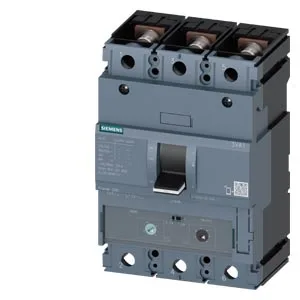
Siemens SENTRON 3VA1225-5EF32-0HH0 — 250 A MCCB for Line Protection
The Siemens SENTRON 3VA1225-5EF32-0HH0 is a 3-pole molded case circuit breaker (MCCB) rated for line protection, carrying 250 A continuously at 40 °C ambient. With a breaking capacity of 187 kA at 240 V AC, it handles high-fault scenarios typical in industrial distribution panels — the sort of SCCR that keeps upstream transformers from taking a hit during a bolted fault. This is an active-production part from the SENTRON family, so no last-time-buy scramble. The 70 mm depth and 105 mm width fit standard MCCB mounting footprints in switchgear assemblies — measure your existing bus bars and mounting holes before committing the BOM line.
Current Rating and Thermal Derating
Rated 250 A up to 50 °C, then derates linearly: 243 A at 55 °C, 237 A at 60 °C, 230 A at 65 °C, and 223 A at 70 °C. If your panel ambient runs 60 °C — say, a crowded enclosure with drives — the breaker still delivers 237 A continuous without nuisance tripping. The 57 W maximum power loss at full load is heat you need to vent; factor that into your enclosure thermal budget.
Breaking Capacity Across Voltages
Breaking capacity drops as system voltage rises: 187 kA at 240 V, 121 kA at 415 V, 75.6 kA at 440 V, 30 kA at 500 V, and 17 kA at 690 V. For a 480 V distribution panel, the 75.6 kA figure gives you headroom above typical 65 kA SCCR requirements — useful for utility-feed applications where fault current runs high.
Environmental and Mechanical Specs
Operates from -25 °C to 70 °C ambient; storage range is -40 °C to 80 °C. The 800 V rated insulation voltage covers most low-voltage networks up to 690 V phase-to-phase. Includes a trip indicator and a voltage trigger for remote status — useful for a PLC DI to log breaker state without a separate aux contact block.
Auxiliary Switching and Release Configuration
Comes with 2 auxiliary switches plus 1 trip alarm switch (HQ), and a shunt trip release (STL) for remote tripping. No undervoltage release fitted, no ground-fault monitoring module. The shunt trip lets a safety PLC or E-stop circuit kill the breaker directly — wire it to a 24 VDC signal from your safety relay.
