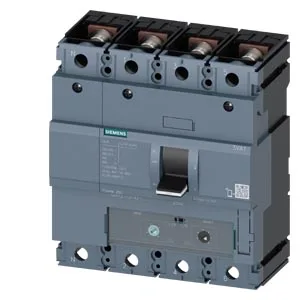
What it is and what it does
The Siemens SENTRON 3VA1225-5FF42-0AC0 is a 4-pole molded case circuit breaker (MCCB) rated for line protection, carrying a continuous current Iu of 250 A. It's built around a TM240 thermal-magnetic overcurrent release, which means the thermal element handles overloads and the magnetic element handles short-circuits — no electronic trip unit, no voltage trigger, no communication module. This is a straight electromechanical breaker for standard distribution and feeder protection.
Breaking capacity — the real coordination number
The breaking capacity tells you where this breaker can sit in a fault hierarchy. At 240 V it clears 187 kA; at 415 V it clears 121 kA; at 440 V it clears 36 kA; at 690 V it clears 17 kA. That 187 kA figure at 240 V is high — this is a breaker for high-fault locations like a main service entrance or a large sub-distribution board where the available fault current is substantial. The drop to 36 kA at 440 V is still well above typical industrial panel SCCR requirements (usually 10–65 kA), so it gives headroom for coordination studies.
Thermal derating — don't size by the nameplate alone
The 250 A rating holds flat from 40 °C through 50 °C. At 55 °C it derates to 243.3 A; at 60 °C to 236.5 A; at 65 °C to 229 A; at 70 °C to 223 A. If your panel ambient runs hot — say near the top of a sealed enclosure or next to a transformer — use the 70 °C figure (223 A) as your actual continuous current limit, not the 250 A nameplate. The insulation voltage rating is 800 V, which covers 480 V and 600 V class systems with margin.
Physical fit and auxiliary wiring
Dimensions: 140 mm wide, 158 mm high, 70 mm deep. That's a standard 4-pole MCCB footprint — it will fit most DIN-rail or panel-mount bases designed for the SENTRON 3VA platform. The front face carries IP40 protection (finger-safe, not washdown). It ships with 2 auxiliary switches (HQ type) pre-installed, which saves a separate order for status feedback to a PLC or indication lamp. No undervoltage release, no shunt trip, no ground-fault module — if you need those, this is the base variant without them.
