What this MCCB delivers — and what the ratings actually mean for your panel
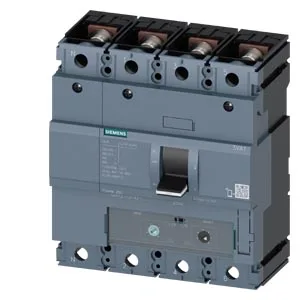
The Siemens SENTRON 3VA1225-5FF42-0KA0 is a 4-pole molded case circuit breaker (MCCB) rated for 250 A continuous current with a TM240 thermal-magnetic release. That 250 A holds flat from 40 °C through 50 °C, then derates to 243.3 A at 55 °C and 223 A at 70 °C — so in a warm enclosure you lose about 11% of headroom by the time you hit 70 °C ambient. The interrupting ratings are what drive the bus bracing decision: 187 kA at 240 V, 121 kA at 415 V, 36 kA at 440 V, and 17 kA at 690 V. At 415 V that 121 kA covers most industrial secondary distribution fault levels without needing a current-limiting fuse upstream.
Sizing and selectivity — the TM240 release and N-conductor protection
The TM240 release is a fixed thermal-magnetic type, not electronic, so you set it once and it tracks the cable rating. The N-conductor protection is set at 50 % of the phase rating, which is typical for 4-pole breakers feeding loads where the neutral is sized at half the phase conductors — common in North American 277/480 V Y panels. The 800 V rated insulation voltage (Ui) means it can sit on a 690 V bus without derating the dielectric clearance.
Panel fit and physical integration
The breaker measures 158 mm high, 140 mm wide, and 70 mm deep — a standard 4-pole MCCB footprint that drops into most SENTRON distribution panels and switchboards. Front protection is IP40, so it is dust-protected on the face but not sealed against hose-down; keep it inside a cabinet rated for the environment. No auxiliary contacts, no undervoltage release, no communication module are fitted on this variant — those are add-on options (the shunt trip STL is available as a separate accessory, order code 3VA9688-0BL33).
What the interrupting ratings mean for your fault-current study
The 187 kA at 240 V is the highest rating on this breaker — it covers 240 V delta secondary services where the transformer can deliver massive fault current. At 415 V the 121 kA still exceeds what most 2 MVA substations can push into a bolted fault. At 690 V the 17 kA is lower but still adequate for most 690 V drives and motor control centers; if your available fault current exceeds that, you need a current-limiting fuse ahead of it or a higher-rated frame.
