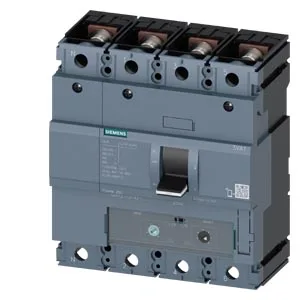
The Siemens SENTRON 3VA1225-5GF42-0AB0 is a 250 A, 4-pole molded case circuit breaker (MCCB) built for line protection — the front-end disconnect in a distribution panel, not a motor-protective device. It carries a TM240 thermal-magnetic release, meaning the thermal element tracks the load current continuously and the magnetic element trips instantaneously on a hard short. The interrupting capacity at 240 V is 187 kA, so it handles utility-level fault currents without cascading upstream. Rated insulation voltage is 800 V, which gives headroom for 480 V and 600 V class systems. The 4-pole design switches all three phases plus neutral — common in North American panelboards where the neutral is switched for service disconnect isolation.
Interrupting capacity and thermal derating
This MCCB's interrupting capacity drops as system voltage rises: 187 kA at 240 V, 121 kA at 415 V, 75.6 kA at 440 V, 30 kA at 500 V, and 17 kA at 690 V. That's typical for a high-interrupting frame — the 690 V figure still covers most industrial secondary-side faults. For selectivity studies, use the 415 V value as the worst-case for 400 V class systems. Continuous current is 250 A from 40 °C through 50 °C ambient. Above that, derate linearly: 243 A at 55 °C, 237 A at 60 °C, 230 A at 65 °C, 223 A at 70 °C. If the panel ambient runs hot — say, next to a VFD cabinet or in a non-climate-controlled enclosure — the 55 °C or 60 °C figure is the one to size against, not the 250 A nameplate.
Panel fit and mounting
Footprint is 140 mm wide, 158 mm tall, 70 mm deep. That's a standard SENTRON 3VA frame size — it fits the same mounting holes and bus-bar kits as other 250 A frames in the series. The 70 mm depth leaves room in a 200 mm deep enclosure for wiring gutters and bus connections behind the breaker. Power loss at full load is 57 W — a non-trivial heat source in a sealed enclosure. If the panel is NEMA 12 or IP54 with no forced ventilation, account for that 57 W in the thermal budget.
