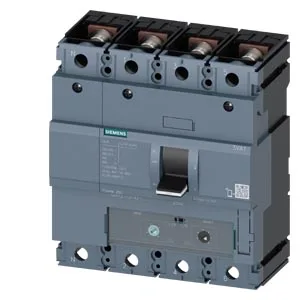
What this MCCB delivers
The Siemens 3VA1225-5GF42-0AJ0 is a SENTRON molded case circuit breaker (MCCB) rated for 250 A continuous current Iu, with a TM240 thermal-magnetic overcurrent release. It is a 4-pole unit configured for line protection — meaning it sits at the feeder or main disconnect position in a distribution panel, not on a motor branch. The interrupting ratings are substantial: 187 kA at 240 V AC, 121 kA at 415 V, 36 kA at 440 V, and 17 kA at 690 V. That 187 kA figure at 240 V tells you this breaker is sized for high-fault-capacity service entrances or large secondary switchgear where available fault current is high. The TM240 release provides fixed thermal and magnetic trip settings; no electronic adjustment, no communication module, no voltage or undervoltage release fitted. The breaker carries 2 auxiliary switches plus 1 trip alarm switch (HP type) as standard — enough to signal position and fault status back to a PLC or SCADA without adding a separate accessory block. Rated insulation voltage Ui is 800 V, and the front face is IP40, so it's suited for installation inside a panel enclosure rated for the environment. Operating temperature range is -25 °C to 70 °C; above 50 °C the continuous current derates from 250 A down to 223 A at 70 °C. If your panel runs hot — say inside a non-conditioned electrical room in a steel mill — plan for that derating curve.
Physical fit and panel integration
Dimensions: 70 mm deep, 140 mm wide, 158 mm tall. That 70 mm depth is the body only — allow clearance for the handle throw and any rear bus connections. The 140 mm width is standard for a 4-pole MCCB in this frame size; verify the mounting footprint against your existing busbar or lug kit spacing. The breaker accepts a 100 % rated N-conductor (full-size neutral), so it can serve as the main disconnect in a 4-wire system without derating the neutral path.
What the TM240 release means on a real line
The TM240 designation means the thermal-magnetic trip unit is calibrated for a 250 A frame. The thermal element handles overload protection with a fixed time-current curve; the magnetic element provides instantaneous short-circuit pickup at roughly 10× Iu (2500 A typical). There is no ground-fault monitoring, no phase-failure detection, and no communication function on this variant. If your application requires adjustable long-time pickup, short-time delay, or ground-fault alarm, you would need a 3VA with an electronic trip unit (ETU) — this is the fixed-setting thermal-magnetic version, which is simpler and more robust for basic feeder protection where coordination studies are already set.
