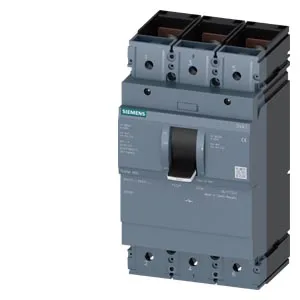
It provides visible-break isolation for a downstream load but carries no overload or short-circuit protection — that is a separate device (a fuse or MCCB) upstream.
The 400 A continuous rating is the full-load current the main contacts can carry without exceeding temperature rise limits. Because this is a switch disconnector — not a circuit breaker — the 400 A figure governs the conductor and busbar sizing, not the fault-clearing capability. The undervoltage release (208-230 V AC) drops the switch open if control power is lost, which is common in safety interlock or emergency-stop chains where you want the load isolated on a power failure. The two auxiliary changeover switches give dry-contact status: one can signal the closed position, the other the open/tripped state, so a controller knows the disconnector position without relying on a voltage presence check.
This is a panel-mount device on the SENTRON 3VA1 frame. It takes a DIN-rail or screw-mount footprint common to IEC switchgear. The nut keeper kit simplifies busbar connection — the nuts stay captive during assembly, which saves time on a multi-pole run. The undervoltage release and aux switches are factory-fitted, so no field wiring of separate accessory blocks is needed. Wire the control supply to the UVR terminals and the aux contacts back to the PLC input card.