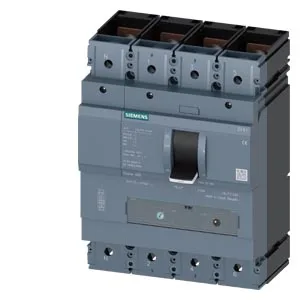
The Siemens SENTRON 3VA1340-5EF42-0BB0 is a 4-pole molded case circuit breaker (MCCB) rated for 400 A at 40 °C, designed for line protection in distribution panels. Its interrupting capacity hits 187 kA at 240 V, dropping to 121 kA at 415 V and 440 V, then 75.6 kA at 500 V, and 11.9 kA at 690 V — so it handles serious fault currents on the low-voltage side but you need to check coordination at higher voltages. The unit includes an undervoltage release (UVR) and comes with two auxiliary switches HP built in, which saves panel space versus adding them later.
Thermal derating and power loss
The breaker holds its full 400 A rating from 40 °C up to 50 °C, then derates linearly: 392 A at 55 °C, 384 A at 60 °C, 376 A at 65 °C, and 367 A at 70 °C. That matters if this sits in a hot panel next to drives or transformers — you lose about 2% per 5 °C above 50 °C. Maximum power loss is 94.6 W, so plan for heat dissipation in the enclosure.
Physical fit and integration
Dimensions are 184 mm wide, 248 mm tall, and 110 mm deep — a standard 4-pole MCCB footprint for Siemens SENTRON 3VA frames. It mounts into a panel via the rear mounting plate; no DIN rail here, so factor in drilling and bus-bar connections. The undervoltage release (UVR) is pre-installed, which means one less wiring step during commissioning — just connect the control voltage.
What the ratings mean for your panel
The 187 kA interrupting capacity at 240 V is what you need for high-fault locations like utility interfaces or large transformer secondaries — it safely clears a bolted fault without the arc flashing upstream. At 690 V, the 11.9 kA figure is lower, so if your system runs at 690 V with high available fault current, this breaker may not be the right choice; check your SCCR study. The 800 V rated insulation voltage gives headroom for 690 V systems. No trip indicator on the front, so troubleshooting a trip requires checking the auxiliary switch status or the UVR state.
