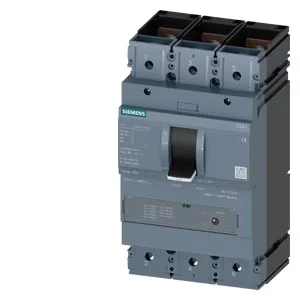
At 240 V it interrupts 187 kA; at 415 V it's 121 kA, and at 690 V it drops to 11.9 kA — so on a 480 V panel you've got solid headroom for most distribution transformers. The interrupting capacity at each voltage level tells you the worst fault it can safely break without welding contacts or venting arc gas into the enclosure.
Full rated current holds at 500 A up to 50 °C; at 55 °C it derates to 488 A, at 60 °C to 476 A, at 65 °C to 464 A, and at 70 °C to 452 A. Maximum power loss is 125.2 W — that's the heat it dumps into the enclosure at full load, which matters for ventilation sizing if you're stacking multiple breakers in a confined space.
Built-in auxiliary and release options
The UVR is a coil that holds in when line voltage is present and drops out if voltage falls below a threshold — so if you lose a phase on the supply side, the breaker trips, protecting downstream motors from single-phasing. The auxiliary switch lets a PLC or annunciator know the breaker's position without running separate sense wires to the load side. The basic switch assembly that carries the trip mechanism is order code 3VA14505MH320AA0 — good to know if you ever need to swap just the switching core and keep the enclosure and terminals.