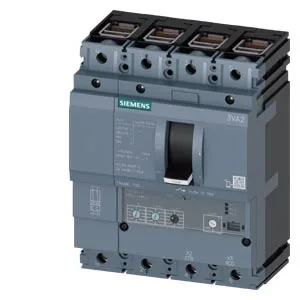
The Siemens 3VA2063-6HL46-0AA0 is a 4-pole SENTRON molded case circuit breaker (MCCB) rated for 63 A continuous at 40 °C through 70 °C — no derating needed across that span, which simplifies panel thermal budgeting. Its ETU320 electronic trip unit gives you adjustable time-delay settings (tr min 0.5 s, tr max 17 s) and an N-conductor protection that can be set to OFF or 100 % of the phase rating. The interrupting ratings are what decide the fit: 242 kA at 240 V, 187 kA at both 415 V and 440 V, 121 kA at 500 V, and 3 kA at 690 V.
The 5.4 W maximum power loss matters for thermal rise calculations in a sealed enclosure; at 63 A continuous that's under 0.1 W per amp, so natural convection in a properly sized cabinet handles it. The 20 000 mechanical endurance cycles are typical for an MCCB in a distribution role — not a switching-duty device, but fine for infrequent manual operation or remote shunt-trip use.
The N-conductor protection can be switched off entirely or set to 100 % of the phase rating, which is useful on 4-wire systems where you want to protect the neutral against harmonic currents without nuisance tripping on unbalanced loads.