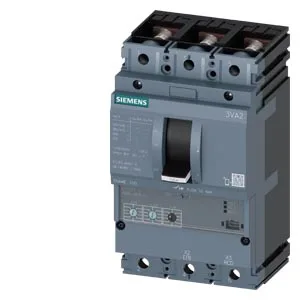
The Siemens SENTRON 3VA2063-6HL32-0AA0 is a 3-pole molded case circuit breaker (MCCB) rated for 63 A continuous current with an ETU320 electronic trip unit, designed for line protection in distribution panels and motor control centers. The 63 A rating holds flat across the full ambient range from 40 °C to 70 °C — no derating needed if your panel runs hot. The ETU320 is an adjustable electronic overcurrent release, which means you can dial in the long-time pickup and short-time delay to coordinate with downstream breakers, rather than being stuck with a fixed thermal-magnetic curve. At 240 V it interrupts 242 kA; at 415 V and 440 V it handles 187 kA; at 500 V it drops to 121 kA; at 690 V it's still rated at 3 kA. For a 480 V panel in North America, the 187 kA at 440 V is the closest reference — well above typical available fault current in most commercial and light industrial installations. The 3 kA at 690 V limits its use on 600 V class systems to low-fault locations unless upstream current-limiting fuses are used.
Dimensions are 105 mm wide, 181 mm high, 86 mm deep — a standard 3-pole MCCB footprint that drops into most SENTRON distribution panels and wall-mount enclosures without re-drilling.
What the ETU320 trip unit buys you
This lets you coordinate the breaker with downstream devices so only the faulted branch trips, not the whole panel.