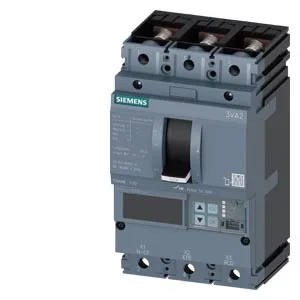
What this MCCB is and what it does
The SENTRON 3VA2063-7KQ32-0AA0 is a 3-pole molded case circuit breaker (MCCB) rated for 63 A continuous current at 40 °C, designed for line protection in distribution panels. Its 330 kA breaking capacity at 240 V means it can safely interrupt very high fault currents without upstream damage — a key spec for high-fault locations like transformer secondaries or large motor control centers. The 800 V rated insulation voltage gives headroom for 480 V and 600 V class systems.
Breaking capacity across voltages — where it fits
Breaking capacity drops as voltage rises: 330 kA at 240 V, 242 kA at 415 V and 440 V, 187 kA at 500 V, and 3 kA at 690 V. That 3 kA at 690 V is the weak point — this breaker is not your primary choice for 690 V distribution unless the available fault current is known to be under that threshold. For 400 V class panels (common in European industrial plants), 242 kA covers virtually any installation.
Thermal performance — no derating needed up to 70 °C
Rated current holds at 63 A from 40 °C all the way to 70 °C ambient. That's unusual — most MCCBs start derating above 40 °C. If your panel runs hot (enclosed switchgear, solar combiner boxes, Middle East installations), this breaker keeps its full 63 A rating without a downsized frame. Operating range is -25 °C to 70 °C; storage from -40 °C to 80 °C.
Ground-fault monitoring and communication
This variant includes ground-fault monitoring via summation current formation on the L-conductor — it measures the vector sum of phase currents to detect leakage to earth. Communication function is built in, so it can report status and trip events to a PLC or BMS over the plant network. No undervoltage release or voltage trip fitted on this order code.
Physical fit and panel integration
Dimensions: 181 mm high, 105 mm wide, 86 mm deep. That 105 mm width is the standard 3-pole MCCB footprint — fits most DIN-rail or panel-mount enclosures without surprises. Power loss is 3 W max, negligible for thermal budgeting in a crowded cabinet.
