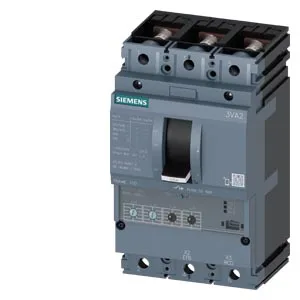
Its continuous current rating is 63 A across the full ambient range from 40 °C to 70 °C, so no derating curve to calculate for warm panel environments; the breaker holds its 63 A trip threshold from a 40 °C panel up to a 70 °C enclosure interior.
The 86 mm depth (3.39 in) matters for enclosure depth planning: a 200 mm deep enclosure leaves clearance for wiring and the arc-chamber exhaust path. The 105 mm width (4.13 in) governs the number of poles that fit across a standard 600 mm wide panel section — four of these fit side-by-side with room for branch wiring gutters.
Key ratings in context
The adjustable thermal-magnetic trip unit has a minimum setting of 16 A and a maximum of 756 A — the 756 A figure is the frame's ultimate short-time withstand, not the continuous rating; the continuous rating is fixed at 63 A. The breaker does not include an undervoltage release or communication module on this variant, so it is a standalone thermal-magnetic trip unit without remote tripping or status feedback. Ground-fault monitoring is via summation current formation on the L-conductor, meaning it can detect residual currents by summing the phase currents through a common-core CT — useful for IT or TN-S systems where ground-fault detection is required.