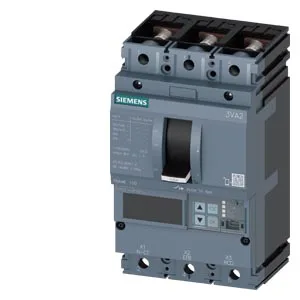
That 63 A holds steady at every temperature step in between, which simplifies panel sizing when the enclosure runs hot. The headline interrupting rating is 440 kA at 240 V, dropping to 330 kA at 415 V and 440 V, then 220 kA at 500 V, and 53 kA at 690 V. It ships with an ETU550 electronic trip unit — that's the programmable overcurrent release that lets you dial in long-time pickup, short-time delay, and instantaneous thresholds. The adjustable response time for the short-time delay (tsd) ranges from 0 to 0.5 s, and the long-time ramp (tr) is adjustable between 0.5 and 25 s. That flexibility is what makes this breaker suitable for selective coordination downstream of a main breaker: you can delay the trip long enough to let a branch device clear a fault first.
Where it fits — panel integration and environment
That's typical for a panel-mounted MCCB; the enclosure itself carries the overall IP rating. Maximum power loss is 3 W.
Communication function is built in (yes), which means the ETU550 can interface with a communication module for remote monitoring and trip-event logging — useful if you're building a smart panel with power monitoring upstream.