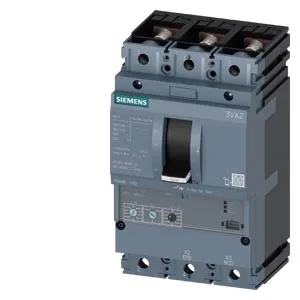
It carries the ETU350M electronic overcurrent release, which gives you adjustable thermal-magnetic curves plus phase-failure detection — that last one is the difference between a nuisance trip on a lost phase and a motor that cooks. The 330 kA breaking capacity at 240 V AC means it can interrupt a fault up to that level without the arc climbing into the buswork; at 690 V it still holds 52.5 kA, which covers most industrial service-entrance and feeder applications.
Breaking capacity across voltages — selectivity headroom
The interrupting ratings span the common industrial voltages: 330 kA at 240 V, 242 kA at both 415 V and 440 V, 187 kA at 500 V, and 52.5 kA at 690 V. For a panel designer chasing full selectivity downstream of a transformer, those numbers give you room to coordinate with smaller branch breakers without cascading the whole board.
At 55 °C it derates to 96 A, at 60 °C to 94 A, and at 70 °C to 90 A. Dimensions are 181 mm high, 105 mm wide, 86 mm deep; it fits the standard SENTRON 3VA mounting footprint, so a panel laid out for a 3VA1 or 3VA2 frame accepts this unit without re-drilling the backplate.
Auxiliary contacts and release configuration
This variant ships with 2 auxiliary switches (HQ type) built in — no separate add-on block to order and snap on. If your safety circuit requires a UVR or GF trip, you need a different suffix.