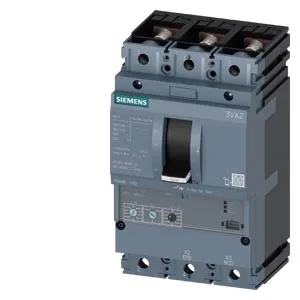
At 240 V it interrupts 330 kA; at 415 V and 440 V it holds 242 kA; at 500 V it's 187 kA; at 690 V it drops to 52.5 kA. Thermal derating is where most spec sheets get ignored and panels get hot. At 55 °C it's 96 A, at 60 °C it's 94 A, at 65 °C it's 92 A, and at 70 °C it's 90 A. The maximum power loss of 75 W also contributes to internal heat rise; factor that into your thermal simulation.
The width is the critical dimension for multi-breaker spacing in a distribution block; 105 mm per pole set means three of these side-by-side eat 315 mm of rail. No auxiliary contacts are fitted from the factory (auxiliary contact version is listed as without), so if you need status feedback to a PLC, you'll add the 3VA9608-0BB25 auxiliary trip block separately.
What it protects and how it communicates
The ETU350M trip unit is the electronic brain. It's a motor protection variant, which means it includes phase failure detection — a common cause of single-phasing on three-phase motors. It does not have a communication function (no Modbus, no PROFIBUS), so all settings are local via the trip unit dials. For frequent switching applications, you'd want a contactor ahead of this breaker; the MCCB is the protection device, not a switching device. The storage range is wider because the breaker isn't dissipating heat when stored — that's the handling limit, not the running limit. No trip indicator and no voltage trigger are fitted; the undervoltage release is the only integrated auxiliary release. Ground fault monitoring is not included, so if you need GF protection, you'll need an external module or a different variant.