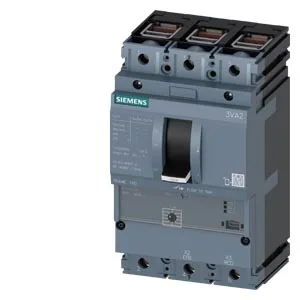
What this 3VA2110-7MS36-0CH0 is and what it does
The Siemens SENTRON 3VA2110-7MS36-0CH0 is a 3-pole molded case circuit breaker (MCCB) designed specifically for starter protection — meaning it's built to handle the high inrush and overload profile of motor starters, not just general distribution loads. It carries a flat 100 A rating across the entire ambient temperature range from 40 °C up to 70 °C, so no derating curve to calculate when the panel runs hot. The adjustable thermal-magnetic trip unit covers 300 A to 1 500 A, giving you a wide window to match the motor full-load current and branch-circuit protection requirements without swapping the breaker body. Breaking capacity is the real headline here: 330 kA at 240 V AC, 242 kA at 415 V and 440 V, still 187 kA at 500 V, and drops to 3.7 kA at 690 V. That 330 kA figure at 240 V is well into high-fault territory — typical for large transformer secondaries or industrial busway feeds where a standard 65 kA or 100 kA MCCB would need a current-limiting fuse ahead of it. At 690 V the 3.7 kA tells you this breaker is not intended for 690 V motor circuits; it's a 240–500 V machine.
Panel fit and integration
Footprint: 105 mm wide, 181 mm tall, 86 mm deep. That 105 mm width is a standard 3-pole MCCB frame — it occupies three 35 mm DIN-module positions if panel-mounted, though the SENTRON 3VA series typically bolts to a mounting plate or busbar system rather than snapping onto DIN rail. The 86 mm depth means it clears most 200 mm deep enclosures with room for rear busbars and wiring troughs. This unit ships with an undervoltage release (UVR) and two auxiliary switches plus one trip alarm switch (HQ configuration). The UVR ensures the breaker drops out if control voltage is lost — standard for safety circuits on motor starters where a loss of control power should kill the motor. The auxiliary switches give remote status indication of the breaker position (open/closed) and the trip alarm signals a fault condition separately. No communication module or phase-failure detection on this variant — it's a straightforward electromechanical MCCB with hardwired aux contacts.
