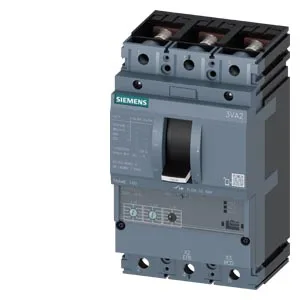
The Siemens 3VA2116-5HL32-0JC0 is a SENTRON molded case circuit breaker (MCCB) rated for 160 A continuous current across the full ambient range from -25 °C to 70 °C, so no derating is needed for most panel environments — it holds 160 A at 40 °C, 45 °C, 50 °C, 55 °C, 60 °C, 65 °C, and 70 °C alike. The interrupting capacity is substantial: 187 kA at 240 V AC, 121 kA at 415 V and 440 V, 75.6 kA at 500 V, and 3.7 kA at 690 V. Power loss is 25.5 W maximum — a figure to factor into enclosure thermal calculations, especially in a crowded panel.
What the shunt trip and auxiliary switches mean for integration
The shunt trip (STL) on this MCCB lets a remote pushbutton, safety relay, or PLC digital output trip the breaker without a handle throw — useful for emergency-stop circuits or remote load shedding. The two auxiliary switches HQ provide form-C contacts that follow the breaker's open/closed and tripped status, so a controls integrator can wire them back to a DI module for status monitoring without adding a separate contact block. No undervoltage release is fitted, so the breaker does not drop out on a voltage dip — that is a deliberate choice for applications where nuisance tripping on a sag is unacceptable.