That 160 A holds flat through 50 °C (–), then derates to 154 A at 55 °C and 136 A at 70 °C (–), so if this breaker lives in a hot enclosure near drives or transformers, the actual ampacity you can count on is the derated value, not the nameplate 160 A. The interrupting ratings tell you where this breaker can be applied without cascading upstream: 187 kA at 240 V, 121 kA at 415 V and 440 V, 79 kA at 500 V, and 4.25 kA at 690 V (–). The ETU320 is a basic electronic trip unit with no communication, no voltage trigger, no undervoltage release, and no ground-fault monitoring. It is a straight thermal-magnetic replacement path — no bells, no bus. The auxiliary contact version is 2 switches HP, which is enough to signal the breaker state to a PLC or status lamp, but do not expect a shunt trip or alarm contact out of the box.
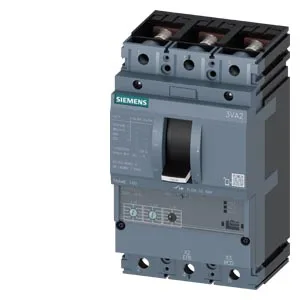
Siemens SENTRON 3VA2116-5HL32-0AB0 MCCB, 160A, 3-Pole, ETU32
Siemens SENTRON 3VA2116-5HL32-0AB0, Molded case circuit breaker, 3-pole, 160 A, ETU320, 187 kA at 240 V.
Specifications
| Parameter | Value |
|---|---|
| Product designation | Molded case circuit breaker |
| Brand / range | SENTRON |
| Product version | Line protection |
| Basic switch (supplied) ref. | 3VA2116-5HL32-0AA0 |
| Integrated auxiliary / alarm switch ref. | 3VA9988-0AA11 |
| Parameter | Value |
|---|---|
| Number of poles | 3 |
| Current at 40 °C | 160 A |
| Current at 45 °C | 160 A |
| Current at 50 °C | 160 A |
| Current at 55 °C | 154 A |
| Current at 60 °C | 148 A |
| Current at 65 °C | 142 A |
| Current at 70 °C | 136 A |
| Switching capacity class | M |
| Breaking capacity at 240 V | 187 kA |
| Breaking capacity at 415 V | 121 kA |
| Breaking capacity at 440 V | 121 kA |
| Breaking capacity at 500 V | 79 kA |
| Breaking capacity at 690 V | 4.25 kA |
| Power loss, max. | 25.5 W |
| Parameter | Value |
|---|---|
| Overcurrent release (trip unit) type | ETU320 |
| Parameter | Value |
|---|---|
| Main circuit connection type | Lug terminal |
| Main circuit connector arrangement | Front terminal |
| Protection class (IP), front | IP40 |
| Parameter | Value |
|---|---|
| Undervoltage release | No |
| Voltage trigger | No |
| Trip indicator | No |
| Communication function | No |
| Measurement function | No |
| Motor drive option | Yes |
| Auxiliary CO contacts | 2 |
| Parameter | Value |
|---|---|
| Operating temperature, max. | 70 °C |
| Operating temperature, min. | -25 °C |
| Storage temperature, max. | 80 °C |
| Storage temperature, min. | -40 °C |
| Parameter | Value |
|---|---|
| Height | 181 mm |
| Width | 105 mm |
| Depth | 86 mm |
Product details
Frequently asked questions
How do I get current pricing and availability for 3VA2116-5HL32-0AB0?
Submit an RFQ. This part is sourced to order through independent distribution; availability and current pricing are confirmed at quote time.
When sourcing 3VA2116-5HL32-0AB0, what is the closest functional second-source — 3VA1010-2ED32-0JA0?
The 3VA1010-2ED32-0JA0 is a different frame size (100 A class) with a different trip unit. It will not drop into a panel wired for the 3VA2116 without rewiring the bus bars and re-evaluating the trip curve. The 3VA2116-5HL32-0AB0 is the correct 160 A, 3-pole, ETU320 variant.
What is 3VA2116-5HL32-0AB0's listed depth (86 mm) on this component line?
The depth is 86 mm. That is the overall depth including the front cover and terminals.
What is 3VA2116-5HL32-0AB0's listed width (105 mm) on this component line?
The width is 105 mm. That is the standard 3-pole frame width for this SENTRON series.
Will 3VA2116-5HL32-0AB0 drop into a panel that was specified around 3VA1010-2ED32-0JA0 without rewiring?
No. The 3VA1010-2ED32-0JA0 is a 100 A frame (different width and bus-bar spacing). The 3VA2116-5HL32-0AB0 is a 160 A frame (105 mm wide). The mounting hole pattern and bus connections differ.
What compliance documentation does this brand provide for 3VA2116-5HL32-0AB0 (RoHS, REACH, UL, IEC)?
As a Siemens SENTRON MCCB, it carries the standard IEC/UL certifications for the series. Specific RoHS/REACH declarations are available from Siemens on request. The evidence does not list individual certs, but the SENTRON line is globally approved for IEC 60947-2 and UL 489.