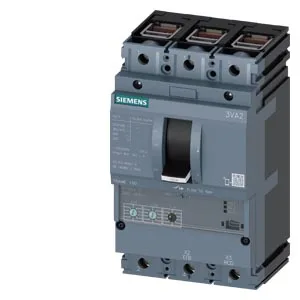
It carries a rated insulation voltage of 800 V and delivers a breaking capacity of 187 kA at 240 V, 121 kA at 415 V and 440 V, 75.6 kA at 500 V, and 3.7 kA at 690 V. Common in safety circuits where loss of control power should kill the main feed.
Thermal performance and panel fit
That's unusual for a molded case breaker; most start dropping above 40 °C. It means you can pack this into a hot panel or near other heat sources without recalculating the load schedule. The 105 mm width is three pole spaces at 35 mm each, so it occupies the same DIN-rail or mounting-plate real estate as any 3-pole MCCB in this class.
At 415 V (common in industrial three-phase worldwide) it still holds 121 kA. That's a high-interrupting-capacity (HIC) breaker, not a standard 25 kA or 36 kA unit. If your available fault current is above 100 kA at the main lug, this is the right class of breaker. At 690 V the capacity drops to 3.7 kA, which is typical for MCCBs at that voltage — you'd rarely see a 690 V fault that high in practice. The trip indicator is not fitted on this variant — no visible flag or push-to-trip button on the front. That's worth knowing for troubleshooting: you'll need to check the breaker handle position or use an external indication. The communication function is also absent; this is a standalone breaker, not a networked power distribution unit.