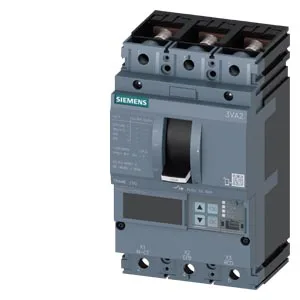
The Siemens SENTRON 3VA2116-5KP32-0HA0 is a 3-pole molded case circuit breaker (MCCB) rated for line protection, carrying a continuous current of 160 A at 40 °C and a rated insulation voltage of 800 V. Its breaking capacity reaches 187 kA at 240 V, 121 kA at 415 V and 440 V, 79 kA at 500 V, and 4.25 kA at 690 V — a steep drop at the top end that matters when the system voltage sits above 500 V.
Thermal derating — the real continuous current at your panel ambient
Above that, the curve steps down: 154 A at 55 °C, 148 A at 60 °C, 142 A at 65 °C, and 136 A at 70 °C. If your enclosure runs at 60 °C — common in a packed, sealed panel — the usable current is 148 A, not 160 A. That 12 A gap can trip a borderline feeder.
Breaking capacity — selectivity headroom and the 690 V cliff
At 240 V the 187 kA rating gives substantial headroom for high-fault locations like a main service entrance or a large transformer secondary. The drop to 79 kA at 500 V is still strong for a 160 A frame. For that application, a higher-frame or higher-voltage-rated MCCB is needed.
Verify the depth clearance against your enclosure door and busbar stack; 86 mm is moderate for an MCCB with an electronic trip unit.
Power loss and auxiliary release
Maximum power loss is 25.5 W — relevant for thermal budgeting in a sealed enclosure. The shunt trip (STL) is built in; no separate undervoltage release is fitted. There is no auxiliary contact version, no ground-fault monitoring, and no phase-failure detection on this variant. The trip indicator is also absent, so remote status relies on the communication function.