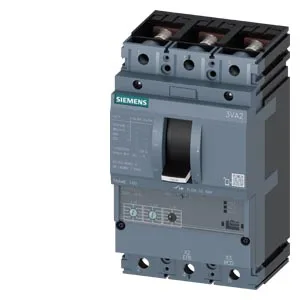
The Siemens 3VA2116-6HL32-0CA0 is a SENTRON molded case circuit breaker (MCCB) rated for 160 A continuous current across the full ambient range from 40 °C to 70 °C — no derating needed up to that ceiling. That flat thermal curve is the standout here: most MCCBs start shedding current above 40 °C, but this one holds 160 A all the way to 70 °C, which simplifies panel design in hot enclosures or near other heat sources.
Interrupting capacity and selectivity
Three-pole design with a 242 kA interrupting rating at 240 V and 187 kA at 415 V. At 500 V it still delivers 121 kA, dropping to 3.7 kA at 690 V. The high fault-current headroom at common distribution voltages (240–415 V) means this breaker can be used as a main or feeder in high-capacity panels where upstream fault current is substantial — no need to oversize to the next frame just for SCCR.
Undervoltage release and line protection
Fitted with an undervoltage release (UVR) as standard — the auxiliary release type is undervoltage release (UVR). This is a line-protection design, not a motor-protection breaker; it's intended for cable and busbar protection in distribution panels. The UVR will trip the breaker if supply voltage drops below a set threshold, which is useful for preventing reclosure after a brownout or for interlocking with emergency-stop circuits.
Physical fit and panel integration
Dimensions are 181 mm high, 105 mm wide, 86 mm deep. That's a standard 3-pole MCCB footprint for the SENTRON 3VA2 frame — mounts on a DIN rail or direct-panel with the appropriate mounting kit. The 86 mm depth is shallow enough for most 200 mm deep enclosures, leaving room for wiring gutters. No trip indicator on the front face, so you'll rely on the handle position or a remote auxiliary contact for status indication.
Rated insulation voltage is 800 V, and maximum power loss is 28 W. Operating temperature range is -25 °C to 70 °C; storage range is -40 °C to 80 °C. The basic switch assembly carries order code 3VA21166HL320AA0 — useful to know if you're sourcing the internal mechanism separately for a repair rather than replacing the whole breaker.
